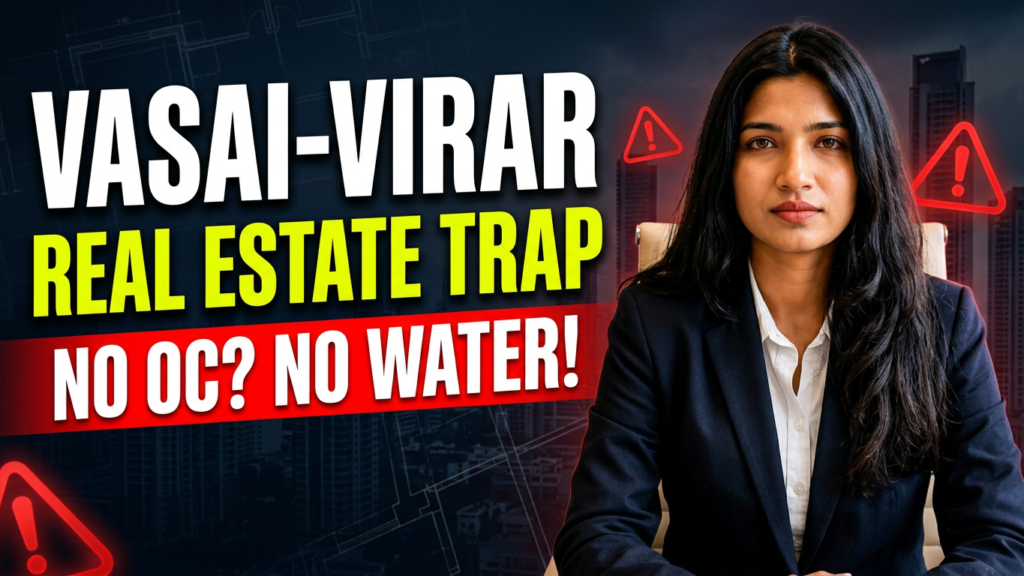
The Real Estate Trap in Vasai-Virar:Legal Risks, Water Crisis & Hidden Costs
The Real Estate Trap in Vasai-Virar:Legal Risks, Water Crisis & Hidden Costs Why a Cheap Flat Can Become an Expensive Mistake For thousands of middle-class families, Vasai-Virar appears to offer something increasingly difficult to find in Mumbai: affordable homeownership. A property that may cost well above ₹1 crore in many established Mumbai suburbs can sometimes be found in the Vasai-Virar region at a substantially lower entry price. Advertisements regularly highlight 1 BHK and 2 BHK apartments at prices that appear within reach of salaried families. But the headline price of a flat is only one part of the calculation. A property can be inexpensive because the land is cheaper, the location is farther from major employment centres, infrastructure is still developing—or because the project carries risks that a buyer has not properly investigated. This is particularly important in parts of the Vasai-Virar market where buyers may encounter questions surrounding land title, development permissions, building approvals, water supply, drainage, access roads and completion documentation. The fundamental rule for a property buyer should therefore be simple: Do not buy a property because the price per square foot looks attractive. Buy only after establishing that the land, construction and occupancy are legally and practically sustainable. This article examines the major risks that prospective buyers should investigate before purchasing a flat in Vasai-Virar. 1. The Price Illusion The biggest attraction of Vasai-Virar is obvious: affordability. For a first-time buyer, the difference between purchasing a home in a relatively expensive Mumbai suburb and buying in an outer suburban market can be enormous. A family with a limited budget may therefore see Vasai, Nalasopara or Virar as an opportunity to finally own a home. But comparing properties purely on ₹ per square foot can be misleading. Two hypothetical properties Property A Price: ₹45 lakh Attractive advertised rateLimited amenities Private water tanker dependence Unclear documentation Difficult resale Property B Price: ₹52 lakh Slightly higher rate Clear title Proper municipal approvals Occupancy documentation Reliable water arrangement Established society Easier institutional financing The second property is more expensive at the time of purchase. But the first property may carry substantially greater financial risk. That is why the first question should not be: “How much is the builder charging per square foot?” It should be: “What exactly am I buying, and can I legally and practically own it for the next 20–30 years?” 2. The Most Important Risk: Land Title The foundation of every real estate transaction is the land. A beautifully constructed building does not eliminate problems originating from the underlying land. Before purchasing, a buyer should investigate the property’s title chain and establish who actually owns the land and whether the seller or developer has legally transferable rights. 7/12 extract Property Card, where applicable Mutation entries Registered title documents Previous conveyances Development agreements Power of Attorney documents, where applicable Title search report Encumbrance information Court cases or disputes affecting the property Applicable land-use permissions Non-Agricultural conversion documentation, where required Why the 7/12 extract matters The 7/12 extract can provide important information about land ownership and land-related entries. But a 7/12 extract by itself is not a substitute for a complete title investigation. A buyer should not assume: “My name will be on the agreement, therefore the title must be clear.” Property ownership involves a chain of rights and documents. For a significant financial investment, an independent property lawyer should examine the title rather than relying solely on the builder’s sales team or a broker. 3. Agricultural Land and Land-Use Questions One area requiring particular attention is the historical and current classification of the land. Agricultural land Non-Agricultural conversion Development Plan zoning Green zones No-development restrictions Reservation of land for public purposes Road widening Environmental restrictions Applicable planning authority The important point is that a building existing physically does not automatically establish that every required permission was legally obtained. This is why a buyer should establish the planning status of the particular parcel rather than relying on statements such as: “Everyone in this area has purchased flats” or “The building has been here for years.” Neither statement proves that the property has a clean title or complete statutory approvals. 4. CC and OC: Two Documents Buyers Should Understand Two terms frequently appear in real estate discussions: CC — Commencement Certificate, and OC — Occupancy Certificate. They should not be treated as interchangeable. A Commencement Certificate relates to permission to commence construction, subject to the applicable sanctioned plans and conditions. An Occupancy Certificate is associated with the authority permitting occupation of a completed development or relevant portion of it after compliance with applicable requirements. The exact documentation varies according to the project and applicable authority. Therefore, buyers should ask for the actual documents, not merely a verbal assurance that “all approvals are there.” The approval relates to the exact building. The sanctioned plans correspond to what was actually constructed. The relevant floors and wings are covered. Conditions attached to approvals have been complied with. The Occupancy Certificate covers the portion being purchased. Any deviations have been regularised, if applicable. A photocopy shown during a sales meeting should not be treated as the end of the investigation. 5. MahaRERA: Important, But Not a Substitute for Due Diligence For projects covered by the applicable RERA framework, buyers should check the project’s MahaRERA registration. Promoter details Project registration Proposed completion Sanctioned plans Project disclosures Litigation-related disclosures where provided Complaints and orders Project progress Uploaded documents However, buyers should avoid another common mistake: “The project has a RERA number, so everything is automatically safe.” RERA registration is an important part of due diligence. It is not a replacement for independent legal verification of title, approvals and the actual property being purchased. 6. The Bank Loan Test There is another practical indicator buyers often overlook: institutional financing. If established banks are willing to finance eligible units in a project, their internal legal and technical processes may provide an additional layer of scrutiny. However, a bank approving a loan does not guarantee that a