
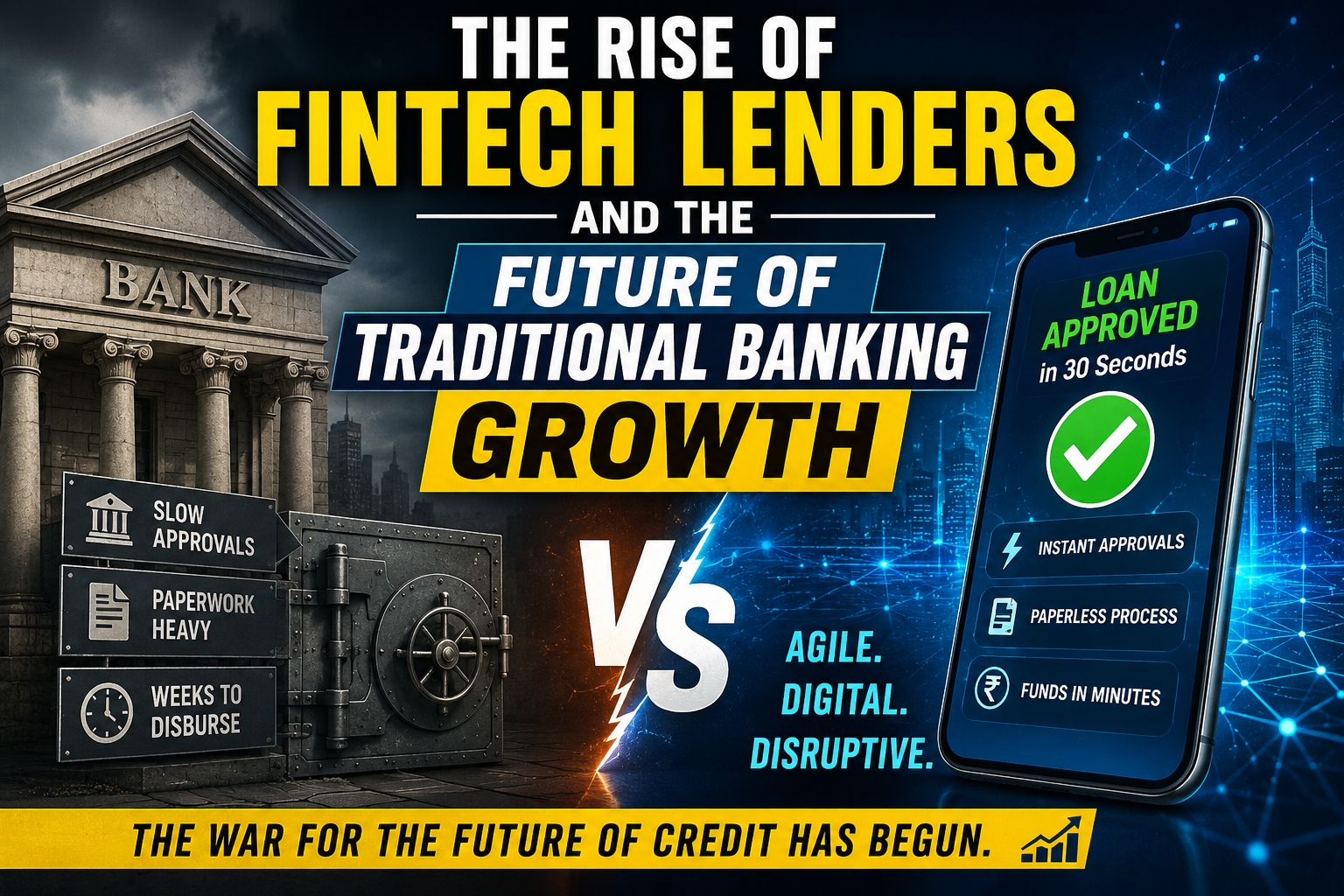
Introduction: The Battle for the Future of Credit
For more than a century, banking success was measured by the size of branch networks, vaults, customer deposits, and lending portfolios. Massive headquarters, thousands of employees, and physical infrastructure symbolized trust and financial strength.
Today, those very strengths are increasingly becoming operational burdens.
A new generation of fintech lenders has rewritten the rules of lending. Instead of relying on paperwork, physical branches, and weeks of manual verification, these companies use artificial intelligence, machine learning, digital identity verification, banking APIs, GST data, UPI transactions, and alternative financial datasets to approve loans within minutes—or sometimes seconds.
The result is one of the biggest transformations in financial services since the emergence of internet banking.
Traditional banks remain dominant in terms of deposits, regulatory standing, and overall assets, but fintech firms are changing customer expectations. The competition is no longer about who has the biggest balance sheet.
It is about who can make the fastest and most accurate lending decision.
This digital revolution is particularly transforming the MSME sector, where millions of businesses have historically struggled to access timely credit.
The question is no longer whether fintech will change banking.
The real question is whether traditional banking growth models can evolve quickly enough to compete.
Why MSMEs Became the Biggest Opportunity
Micro, Small, and Medium Enterprises contribute significantly to employment and economic activity across many countries.
Yet for decades, obtaining business loans remained difficult because of:
- Lengthy paperwork
- Multiple branch visits
- Physical collateral requirements
- Manual income verification
- Limited credit history
- Slow underwriting
Many entrepreneurs simply gave up.
Others depended on informal lending channels.
This financing gap created the perfect opportunity for digital lenders.
Instead of asking:
“How much collateral do you own?”
Fintech asks:
“How does your business perform every day?”
That shift completely changes credit evaluation.
Traditional Banking: Built for Stability
Banks have always prioritized risk management.
Their lending process typically involves:
- KYC verification
- Income assessment
- Credit bureau checks
- Manual underwriting
- Risk committee approval
- Legal documentation
- Loan disbursement
Each stage helps reduce defaults but also increases processing time and operating costs.
This model works well for large loans.
However, it becomes expensive for smaller MSME loans.
A ₹2 lakh business loan may require nearly the same documentation as a ₹2 crore loan.
That economic imbalance creates inefficiencies.
Fintech’s Biggest Advantage: Data Instead of Documents
Modern fintech lenders often evaluate businesses using digital financial signals rather than relying solely on traditional paperwork.
Examples include:
- GST returns
- Bank statement analysis
- UPI collections
- Digital invoices
- E-commerce sales
- Accounting software
- Utility payments
- Tax compliance history
- Payment gateway transactions
AI models analyze thousands of variables simultaneously.
Instead of waiting days for manual verification, automated systems can generate preliminary credit decisions within minutes.
This doesn’t eliminate human oversight in every case, but it significantly reduces processing time.
Artificial Intelligence Is Changing Credit Assessment
Traditional credit scoring often focuses on past borrowing history.
AI-based lending models attempt to build a broader financial picture.
Algorithms may examine patterns such as:
- Cash flow stability
- Seasonal revenue changes
- Customer concentration
- Supplier relationships
- Business growth trends
- Invoice payment cycles
- Inventory turnover
- Digital transaction consistency
Rather than relying on one score, lenders can evaluate multiple risk indicators.
This allows businesses with limited traditional credit histories to become eligible for financing.
Why Physical Branches Are Becoming Less Important
Branches remain valuable for advisory services, complex financial products, and customer relationships.
However, many routine banking activities have already shifted online.
Customers increasingly expect to:
- Open accounts digitally
- Apply for loans online
- Upload documents electronically
- Track applications in real time
- Receive funds digitally
- Repay through automated systems
Fintech firms were designed around these expectations from the beginning.
Traditional banks often have to modernize decades-old technology while continuing daily operations.
That transformation is both expensive and technically challenging.
The Cost Advantage of Digital-First Lending
Maintaining thousands of branches involves significant expenses:
- Rent
- Utilities
- Security
- Staff
- Cash management
- Maintenance
- IT support
Digital lenders generally operate with leaner structures.
Lower operating costs can enable faster scaling and greater flexibility, though they also face substantial investments in technology, cybersecurity, compliance, and customer acquisition.
Automation also reduces repetitive manual work, allowing teams to focus on more complex cases.
Why MSMEs Prefer Digital Lending
Small businesses value speed.
Waiting several weeks for working capital can mean:
- Missed inventory purchases
- Delayed salaries
- Lost contracts
- Cash flow disruptions
Digital lenders often emphasize:
- Faster applications
- Paperless documentation
- Transparent status tracking
- Flexible repayment options
- Smaller loan sizes
- Continuous customer engagement
Convenience has become a major competitive advantage.
Embedded Finance Is Redefining Lending
Many businesses no longer visit a lender to obtain financing.
Instead, loans increasingly appear within platforms they already use.
Examples include:
- E-commerce marketplaces
- Accounting software
- Payment gateways
- POS systems
- Logistics platforms
- Supply chain applications
This model, known as embedded finance, brings credit directly into business workflows.
The lender becomes almost invisible.
Open Banking and API-Based Lending
Financial data sharing—with customer consent and subject to applicable regulations—is expanding digital lending opportunities.
Instead of manually collecting documents, lenders may access verified financial information through secure APIs.
Benefits include:
- Faster verification
- Reduced fraud
- Better underwriting
- Lower operational costs
- Improved customer experience
The future of lending increasingly depends on connected financial ecosystems rather than isolated institutions.
Where Traditional Banks Still Hold the Advantage
Despite fintech’s rapid growth, banks retain significant strengths.
These include:
- Large Deposit Base
- Banks have access to stable funding through customer deposits.
- Many fintech lenders rely on partnerships or external funding sources.
Customer Trust
Established banks have long-standing reputations and regulatory oversight that many customers value.
Broader Product Portfolio
Banks offer:
- Savings accounts
- Current accounts
- Mortgages
- Trade finance
- Wealth management
- Corporate banking
- Treasury services
Fintech companies often focus on narrower product areas.
Strong Regulatory Framework
Banks operate under extensive prudential regulations designed to support financial stability.
Why Banks Are Investing in Digital Transformation
Most leading banks are not ignoring fintech competition.
Many are investing heavily in:
- AI underwriting
- Digital onboarding
- Cloud infrastructure
- Mobile banking
- API integration
- Automation
- Cybersecurity
- Data analytics
Rather than disappearing, many banks are evolving into hybrid institutions that combine traditional strengths with digital capabilities.
Fintech and Banks Are Becoming Partners
The future may not be a winner-takes-all contest.
Increasingly, banks and fintech firms collaborate.
Common partnership models include:
- Co-lending arrangements
- Banking-as-a-Service (BaaS)
- Embedded finance
- White-label lending platforms
- Digital KYC services
- Payment infrastructure partnerships
These collaborations allow banks to leverage fintech innovation while fintech firms benefit from banking infrastructure and regulatory expertise.
The Challenges Facing Fintech Lenders
Rapid growth also brings risks.
Digital lenders must manage:
- Credit quality
- Cybersecurity threats
- Data privacy
- Regulatory compliance
- Customer acquisition costs
- Funding availability
- Fraud prevention
- Model governance
Sustainable growth depends not only on speed but also on prudent risk management.
What Customers Expect in 2026 and Beyond
Businesses increasingly expect financial services to be:
- Instant
- Digital
- Transparent
- Personalized
- Mobile-first
- Secure
- Always available
Institutions unable to meet these expectations may find it harder to compete, although physical banking will likely remain important for many customers and complex financial needs.
The Future of MSME Lending
Several trends are expected to shape the next phase of digital finance:
- AI-Based Underwriting
Smarter risk assessment using diverse data sources. - Real-Time Cash Flow Lending
Credit decisions increasingly based on current business performance rather than historical statements alone. - Embedded Business Credit
Loans integrated directly into commercial software platforms.
Hyper-Personalized Financial Products
Customized pricing and loan structures based on business behavior. - Automated Compliance
Technology reducing documentation and regulatory friction.
Is This the End of Traditional Banking?
No.
But it is the end of traditional banking as many people once knew it. - Physical branches alone no longer define competitiveness.
Technology, customer experience, data intelligence, and operational agility now play central roles in financial services. - Banks that embrace digital transformation are likely to remain highly relevant.
Those that delay modernization may face increasing pressure as customer expectations continue to evolve. - The future is unlikely to belong exclusively to fintech companies or legacy banks.
Instead, it will favor institutions that successfully combine trust, regulatory strength, capital efficiency, and digital innovation.
Conclusion
The financial industry is experiencing one of its most significant transitions in decades.
Fintech lenders have demonstrated that technology can dramatically improve the speed, accessibility, and convenience of business financing, especially for MSMEs.
Traditional banks continue to possess enormous advantages in capital, customer trust, and regulatory experience, but these strengths must increasingly be paired with modern digital capabilities.
The future of banking will not be determined by who owns the tallest headquarters or the largest branch network.
It will be determined by who delivers the smartest, fastest, safest, and most customer-centric financial experience.
For MSMEs, this competition is creating more financing options than ever before.
For banks and fintech firms alike, the message is clear:
The next generation of lending belongs to institutions that innovate without compromising trust.
Frequently Asked Questions (FAQs)
- What is a fintech lender?
A fintech lender is a financial technology company that uses digital platforms, automation, and data analytics to provide loans more efficiently than traditional methods. - Why are fintech lenders popular among MSMEs?
They often offer faster loan approvals, paperless processes, digital applications, and more flexible underwriting models. - Will fintech replace traditional banks?
Not necessarily. Many experts expect increased competition alongside partnerships, with banks and fintech firms serving complementary roles. - How does AI improve lending?
AI can help analyze multiple financial data points, support risk assessment, detect fraud, and streamline loan processing, subject to appropriate governance and oversight. - What is the future of digital lending?
The sector is expected to continue evolving through AI, embedded finance, API connectivity, open banking initiatives, automation, and improved customer experiences, alongside ongoing regulatory developments.