
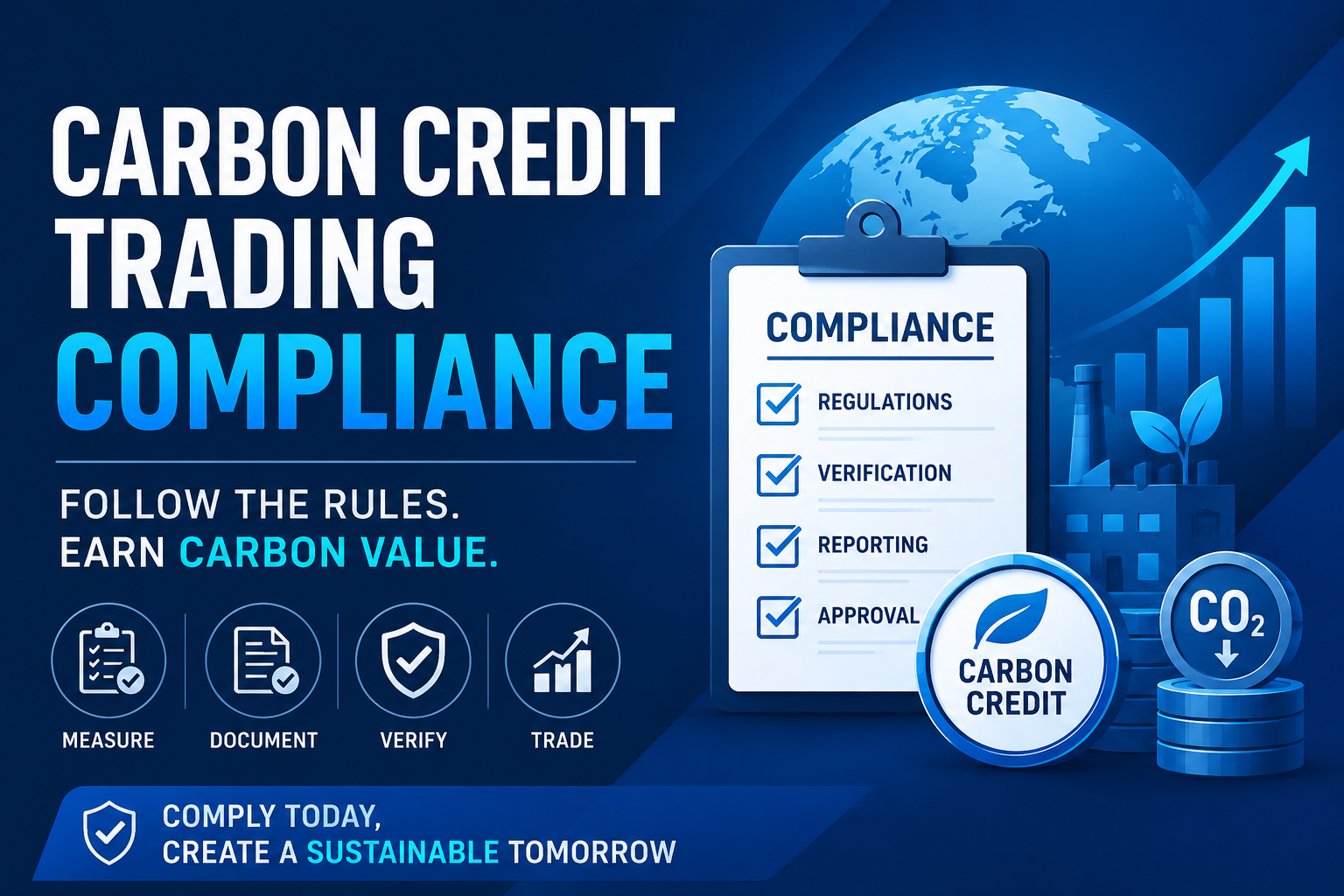
Carbon Credit Compliance for MSMEs: Step-by-Step Guide to Verification, Aggregation and Trading in India (2026)
India’s regulated carbon market is transforming environmental compliance from a legal obligation into a strategic business opportunity. However, earning value from carbon credits is not as simple as reducing electricity consumption or installing solar panels. Businesses must demonstrate that their environmental improvements are measurable, verifiable, and compliant with the applicable regulatory framework.
For many Micro, Small and Medium Enterprises (MSMEs), this is the most confusing part of carbon trading. Terms such as baseline emissions, measurement and verification (M&V), aggregation, carbon accounting, and certificate issuance often appear highly technical.
The good news is that understanding the process is easier when broken into manageable steps. Whether you operate a textile unit, engineering workshop, food processing plant, chemical factory, packaging company, or service enterprise, the same basic principles apply: improve efficiency, document the improvements, verify the results, and participate in the market through the appropriate mechanism where eligible.
Step 1: Establish Your Energy and Emissions Baseline
Every carbon project begins with a baseline.
A baseline represents the amount of energy your business consumed—or the greenhouse gases it emitted—before any efficiency improvements were made. Without a reliable baseline, it is impossible to demonstrate that emissions have actually been reduced.
Typical baseline data may include:
- Electricity consumption records
- Diesel, LPG, natural gas, or coal usage
- Production volumes
- Machine operating hours
- Fuel purchase invoices
- Utility bills
- Existing equipment specifications
Many businesses already possess much of this information through their accounting and operational records. Organizing these records systematically is the first step toward future participation in carbon markets.
Step 2: Identify High-Impact Energy Efficiency Opportunities
Not every investment delivers the same environmental or financial return. MSMEs should focus first on improvements that reduce energy use without affecting production quality.
Common opportunities include:
- Electrical Systems
- Replacing old motors with high-efficiency models
- Installing Variable Frequency Drives (VFDs)
- Improving power factor
- Smart metering
- Automated controls
- Manufacturing Equipment
- Upgrading boilers
- Efficient furnaces
- Heat recovery systems
- Better insulation
- Process optimization
- Buildings and Facilities
- LED lighting
- High-efficiency air conditioning
- Motion sensors
- Efficient water pumps
- Roof insulation
- Renewable Energy
- Rooftop solar
- Solar water heating
- Biomass utilization
- Waste-to-energy systems (where appropriate)
The combination of reduced operating costs and potential carbon value can significantly improve the financial viability of these investments.
Step 3: Build a Reliable Carbon Accounting System
Carbon trading depends on accurate data rather than estimates.
Carbon accounting involves measuring greenhouse gas emissions associated with business operations and tracking changes over time. Even smaller enterprises benefit from maintaining organized records because future verification depends heavily on historical data.
An effective carbon accounting system should include:
- Monthly energy consumption
- Fuel usage
- Production output
- Equipment upgrades
- Maintenance schedules
- Renewable energy generation
- Operational changes
Digital recordkeeping can simplify this process and reduce the likelihood of missing information during verification.
Step 4: Understand Measurement and Verification (M&V)
Verification is the foundation of every credible carbon market.
Independent accredited organizations review whether reported energy savings or emission reductions are genuine, measurable, and supported by evidence.
During verification, reviewers may examine:
- Utility bills
- Meter readings
- Equipment purchase records
- Maintenance documentation
- Production data
- Operational procedures
- Site inspections
The objective is to ensure that claimed environmental benefits are based on actual performance rather than assumptions.
Why Documentation Is More Valuable Than Many Businesses Realize
Many MSMEs invest in efficient machinery but fail to preserve supporting records. Years later, they may struggle to demonstrate the environmental improvements they achieved.
Businesses should retain:
- Purchase invoices
- Installation reports
- Calibration certificates
- Maintenance logs
- Electricity bills
- Fuel invoices
- Production reports
- Audit findings
- Equipment manuals
Strong documentation increases confidence during verification and reduces delays.
Aggregation: The Smart Entry Route for Small Enterprises
One of the biggest barriers for MSMEs is scale.
A single workshop may save only a modest amount of energy each year. On its own, the administrative cost of verification may outweigh the potential benefits.
Aggregation solves this challenge.
Under an aggregation model, multiple MSMEs with similar energy-saving projects can participate collectively. A project developer, Energy Service Company (ESCO), industry association, or specialized sustainability firm coordinates documentation, verification, and market participation.
Aggregation can provide:
- Lower transaction costs
- Shared technical expertise
- Professional compliance support
- Better market access
- Simplified documentation
- Economies of scale
For many small businesses, aggregation is likely to be the most practical pathway into carbon markets.
Understanding Liquidity in Carbon Markets
Generating eligible certificates is only one part of the process. Businesses also need a market where those certificates can potentially be traded.
Liquidity refers to the ease with which buyers and sellers can complete transactions.
A liquid market generally offers:
- More buyers
- Better price discovery
- Faster transactions
- Greater transparency
- Improved confidence
As India’s regulated carbon market develops, liquidity is expected to improve through greater participation and standardized trading mechanisms. However, market conditions can change over time, and prices are influenced by supply, demand, and regulatory developments.
Digital Technologies Are Changing Carbon Compliance
Modern sustainability management increasingly relies on technology.
Businesses are adopting:
- Smart energy meters
- IoT sensors
- Cloud-based monitoring
- Artificial intelligence
- Automated reporting software
- Predictive maintenance systems
These technologies can improve data accuracy, simplify reporting, and help identify additional efficiency opportunities. While they do not replace regulatory verification, they can strengthen internal monitoring.
Financing Green Upgrades
One concern for MSMEs is the upfront cost of energy-efficient equipment.
Possible financing options may include:
- Bank loans
- MSME credit schemes
- Energy Service Company (ESCO) models
- Equipment leasing
- Green finance products
- State or central government support programs (where available)
Before making major investments, businesses should evaluate expected energy savings, maintenance costs, payback periods, and applicable incentives.
Risks Every Business Should Understand
Carbon markets create opportunities, but they also involve responsibilities.
Businesses should recognize that:
- Not every efficiency project qualifies for certificates.
- Regulatory requirements may evolve.
- Verification standards must be met.
- Certificate values are not fixed and can fluctuate.
- Revenue is never guaranteed.
- Accurate documentation is essential.
Seeking advice from qualified professionals before making investment decisions can help businesses understand eligibility and compliance requirements.
Practical Example: A Small Manufacturing Cluster
Imagine twenty small engineering units located in the same industrial estate.
Each business replaces outdated motors, installs LED lighting, improves compressed air systems, and adopts better maintenance practices. Individually, the energy savings may be relatively modest.
By joining an aggregation program, the participating units can consolidate data, undergo coordinated verification, and reduce administrative costs. If the relevant regulatory conditions are satisfied, the combined environmental improvements may support the issuance of tradable certificates, with proceeds shared according to agreed arrangements.
This illustrates how collaboration can make participation more practical for smaller enterprises.
Preparing for the Future
Even businesses that are not immediately eligible for carbon certificates can benefit by strengthening their internal systems today.
Practical actions include:
- Conduct annual energy audits.
- Maintain digital energy records.
- Replace inefficient equipment when economically viable.
- Train staff on energy management.
- Monitor electricity and fuel consumption regularly.
- Follow official notifications related to India’s Carbon Credit Trading Scheme.
- Explore partnerships with experienced aggregators or sustainability consultants.
Early preparation can reduce future compliance costs and position businesses to take advantage of evolving market opportunities.
Frequently Asked Questions
Can every MSME earn carbon credits?
No. Eligibility depends on the applicable regulatory framework, sector-specific rules, the nature of the project, and successful verification.
Is installing solar panels enough?
Solar installations can improve sustainability, but certificate eligibility depends on how the project fits within the relevant rules and verification requirements.
Do I need an energy audit?
An energy audit is often a valuable starting point because it identifies opportunities for efficiency improvements and establishes baseline data.
Is carbon trading risk-free?
No. Market prices, regulations, verification outcomes, and project eligibility can all affect financial returns.
Should small businesses participate alone?
Many MSMEs may find aggregation through experienced organizations more practical than participating independently, particularly during the early stages of the market.
Final Thoughts
India’s Carbon Credit Trading Scheme represents a long-term transformation in the relationship between industrial growth and environmental responsibility. For MSMEs, the greatest opportunity lies not merely in selling certificates but in building efficient, data-driven businesses that are resilient, competitive, and prepared for the low-carbon economy.
The enterprises that begin measuring energy use, maintaining reliable records, and investing in practical efficiency improvements today will be better positioned as India’s regulated carbon market continues to mature. Carbon compliance is no longer just about meeting legal expectations—it is becoming part of a broader strategy for operational excellence, financial resilience, and sustainable growth.